Indonesia · Bangka Belitung Province
Bangka Island:
The Paradise Most Travelers Still Haven't Heard Of
White granite boulders, neon-clear water, and a coastline that hasn't been discovered by the crowds yet. Here's everything you need to know.
Find Flights to Bangka ↗"There's an island in Indonesia where the beaches are still empty, the reefs still intact, and the tin-mining history runs as deep as the ocean floor."
Most people planning a trip to Indonesia have Bali at the top of their list, maybe Lombok or the Gili Islands somewhere underneath it. Bangka Island rarely comes up. That's either a shame or a secret worth keeping, depending on how you look at it. This guide exists because some places deserve to be found before they stop being what makes them special in the first place.
Bangka sits off the southeastern coast of Sumatra, close enough to the mainland that it feels connected to the rhythms of Palembang's river culture, yet far enough out to feel entirely its own. It's part of the Bangka Belitung province, a name that might ring a bell if you've watched the 2008 film Laskar Pelangi, which brought national attention to the region's tin-scarred landscapes and the stubborn optimism of the people who live among them. The film captured something true about this place: there is beauty here that survives everything thrown at it.
Why Bangka and Not Bali
That question might sound provocative but it's actually worth sitting with. Bali is extraordinary. Nobody who's been there argues otherwise. But Bali in 2025 is also a place that takes a little work to experience well. You need to know where the tourists aren't, which means going farther, paying more, or accepting that the sacred and the souvenir shop now stand next to each other on the same block.
Bangka gives you the pre-crowd version of that experience. The kind where you arrive at a beach and it's just there, waiting, with nobody else in it. Where the warung on the sand still charges local prices and the family running it is genuinely curious about why you chose to come here. That gap between "undiscovered" and "underdeveloped" is narrowing every year in Southeast Asia, and Bangka is still on the right side of it — but probably not forever.
If you're ready to actually book the flights, the cheapest and most reliable way to compare options to Pangkalpinang (the island's main airport, code PGK) is through this flight search tool, which pulls from dozens of carriers including the regional Indonesian airlines that serve the island directly.
The Landscape: Granite, Jungle, and That Particular Shade of Blue
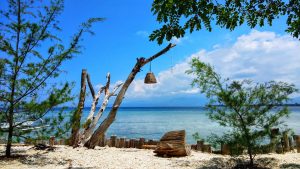
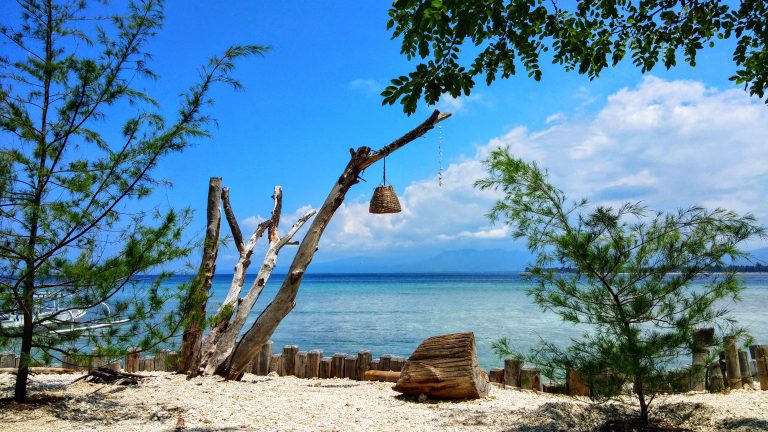
What makes Bangka visually striking is something you don't expect from an Indonesian island: the rocks. Massive granite boulders, worn smooth and grey-white by centuries of sea wind, sit scattered along the shoreline like something dropped there by accident. They frame coves, emerge from shallow water, and create the kind of natural architecture that photographers spend entire careers chasing. Tanjung Kelayang is the most famous example, but you'll find these formations across the island's northern and western coastlines.
The water between the rocks runs colors that don't photograph honestly because nothing does them justice. There's an aquamarine at low tide, a deeper sapphire in the open, and a foamy white where the swells break against the granite. The visibility underwater is exceptional in dry season, which makes Bangka one of the quieter alternatives in Indonesia for snorkeling and diving without the crowds that pile onto the Gili Islands.
Inland, the island shifts into something rawer. Tin mining has shaped Bangka's economy for three centuries, and the land shows it in places: open pits, turquoise-flooded craters, a landscape that looks post-industrial but has developed its own strange beauty. These ex-mining lakes have become unofficial swimming spots for locals, a curious juxtaposition that tells you everything about how Bangka adapts.
The crown jewel. Granite islands offshore, a long white beach, and the departure point for boat trips to Lengkuas Island and its Dutch colonial lighthouse.
Close to Pangkalpinang and ideal for easing in. Calm water, local food stalls, and a relaxed pace that feels genuinely unhurried.
A short boat ride from Tanjung Kelayang, this tiny island hosts a 19th-century Dutch lighthouse you can climb for panoramic views over the Belitung archipelago.
One of Bangka's most photographed stretches, with the granite boulders at their most dramatic and a line of ironwood trees offering afternoon shade.
Getting Around: What Nobody Tells You Before You Arrive
Bangka is not set up for independent travel in the way that Bali or Lombok are. There's no Grab on every corner, no tourist shuttle buses running a well-worn circuit between hotspots. What there is: an airport that receives flights from Jakarta, Palembang, and Batam, a rental car and motorbike scene that's genuinely affordable, and locals who are overwhelmingly happy to point you in the right direction.
Renting a motorbike is the default for solo travelers and couples. The roads are decent, the distances manageable, and there's something specific to riding through the rubber tree plantations at dawn that earns its own category of memory. Families or groups are better off hiring a car with a driver for the day — rates are low by any standard and the drivers almost always know which roadside warung serves the best mie koba.
Flights to Pangkalpinang from Jakarta typically run around 45 to 90 minutes. The Jakarta–Bangka route is served by Garuda, Lion Air, and Citilink among others, and prices swing significantly depending on how far in advance you book. Using a flight comparison platform that aggregates low-cost carriers alongside full-service airlines tends to save a meaningful amount here, especially for travel during Indonesian public holidays when demand spikes sharply.
Practical note: Bangka's best weather runs from May through September, with July and August being the driest and calmest. The wet season (November through March) brings rough seas and reduced boat access to offshore islands. If your trip is flexible, dry season is the obvious call — but shoulder months like April and October offer a reasonable compromise between conditions and smaller crowds even by Bangka's modest standards.
Food: The Real Reason to Come Back
People who've spent time in Bangka tend to talk about the food with a specific kind of devotion. This isn't fusion cuisine or anything that got a write-up in an international food magazine. It's something older than that: a Chinese-Malay culinary tradition that's been developing on this island for three hundred years and has no real equivalent anywhere else.
Mie koba is the dish to start with. A noodle soup made with fish broth that's been reduced to something rich and deeply savory, served with sliced fish cake and a hard-boiled egg. The broth is thinner than you'd expect and more complex than it looks. It's morning food, traditionally, eaten at a plastic table on a concrete floor with a glass of sweet tea, and it sets the emotional register for everything else you'll eat on the island.
Then there's lempah kuning: a yellow fish curry made with local spices and a souring agent that differs from family to family. And otak-otak, fish paste grilled in banana leaf parcels over charcoal, sold from roadside carts and best eaten immediately, standing up, slightly scalding your fingers. Bangka's Chinese population has also given the island a strong tradition of seafood cooked simply — grilled, steamed, or flash-fried with garlic — that rewards anyone willing to point at what looks good in the tank and see what arrives.
History That Sits Just Beneath the Surface
Bangka's tin deposits have been mined since at least the early 18th century, when the Dutch East India Company (VOC) began extracting ore through labor brought in from China's Guangdong province. The descendants of those workers are still here, woven into the island's social fabric in ways that make Bangka feel more culturally layered than its modest profile suggests. Chinese temples sit next to mosques in the older neighborhoods of Pangkalpinang. The Qingming festival is observed with the same seriousness as Eid.
The town of Mentok, on the island's western tip, holds the history most visibly. There's a former Dutch colonial building that served as a colonial administration office, streets of shophouses with faded signage, and a weight and dignity to the older quarters that's different from the energy of the beach towns. It's the kind of place where you wander without a plan and end up sitting somewhere unexpected, talking to someone who's lived there their whole life and has a version of the island's story that no guidebook has written down.
Experiences Worth Planning Around
Bangka's best experiences tend to be physical — in the water, on a boat, walking a beach at a pace that doesn't feel like exercise. But there's a growing layer of structured tourism starting to take shape, and for anyone who wants to move between experiences without the friction of figuring it out alone, booking through a platform that specializes in regional activities makes a real difference.
Island-hopping boat tours to the granite archipelago around Tanjung Kelayang are the most popular organized experience on the island, and they're worth doing at least once. Snorkeling stops at coral gardens that still look healthy, a swim at a sandbar that appears and disappears with the tide, lunch on Lengkuas Island before climbing the lighthouse — the whole thing runs four to six hours and costs a fraction of equivalent experiences in more developed parts of Indonesia.
For those experiences, as well as guided cave exploration, mangrove kayaking, and some of the local cultural tours that have started to emerge around the island's Chinese-Malay heritage sites, this activity booking platform offers curated options with confirmed availability and English-language support — which matters more than it sounds when you're trying to coordinate a boat departure time in a place where the schedule is partly weather-dependent.
On diving and snorkeling
The reefs around Bangka's offshore islands are genuinely impressive by any measure, not just by the "hidden gem" standard. Water clarity in the dry season regularly exceeds 20 meters. The marine life is diverse without being the kind of dramatic megafauna experience that draws dive tourists to places like Komodo — this is reef diving at its quieter best, the kind where you spend an hour in one spot watching a square meter of coral and keep finding something new. There are no big dive schools operating at Bangka's scale yet, which is part of what makes it worth coming to now rather than waiting.
On slowing down
The thing that separates a trip to Bangka from a trip to somewhere more developed isn't really the beaches or the food or the history. It's the pace. There's a quality of time here that's hard to describe without sounding like a travel cliché, but it's real. The mornings are quiet. The afternoons are hot and slow. The evenings are for eating too much and talking to whoever's at the next table. If you arrive already in a rush, Bangka will probably frustrate you. If you arrive ready to let the schedule loosen, it will be the trip you talk about for a while.
Where to stay: Accommodation ranges from simple guesthouses in Pangkalpinang (clean, cheap, run by families who will feed you well) to a small number of boutique resorts along the beach strips near Tanjung Kelayang. Neither end of the scale is expensive by regional standards. Booking ahead in July and August is wise; outside peak domestic travel season, you can usually arrive and find a room.
Ready to Plan Your Bangka Trip?
Two things worth doing right now: compare flights to Pangkalpinang while prices are still reasonable, and browse the available tours and experiences so you know what you want to book once you're there.
A Few Honest Caveats
Bangka is not perfect in the ways that the best travel writing tends to pretend places aren't perfect. The tin mining history has left real environmental scars. Parts of the coastline near industrial areas are not swimming beaches. The infrastructure outside the main towns can be rough, and there are stretches of the island that exist primarily for the people who live there, not for visitors passing through. Treating those spaces with the awareness they deserve matters.
The island's growth as a tourist destination is also uneven. Some of what's being built is thoughtful; some of it isn't. The places where local tourism culture has developed organically tend to be better — in experience and for the people who live there — than the spots where development has moved faster than the community around it has been able to shape.
None of this is a reason not to go. It's a reason to go with the awareness that the choices you make as a traveler — where you eat, where you sleep, which tours you book and through whom — have a real effect on how Bangka develops over the next decade. The places that stay worth visiting tend to be the ones where travelers showed up caring about that.
Bangka Island will not stay this way indefinitely. No place that deserves this much attention ever does. The smart move is usually to go before the crowd arrives, not after, which is the kind of advice that always sounds obvious in retrospect. The flights are bookable. The tours are available. The beaches are, right now, empty in the early morning in a way that probably won't last.
That seems worth acting on.
This guide contains affiliate links. If you book flights or experiences through the links above, a small commission may be earned at no additional cost to you. Recommendations are made independently and reflect genuine experience with the island and these platforms.